


Page 15 - Stories_of_Older_Adults
P. 15
T H E   S T U D Y :   C A N   D O C U M E N T I N G   O L D E R   A D U L T S ’   L I F E   S T O R I E S   I M P R O V E   D E N T A L   S T U D E N T S ’   E M P A T H Y ?


                               W H A T   W E   P L A N N E D
                                                                          C O N T I N U A T I O N


           Our  initial  plan  emphasised  face-to-face  communication,  with
           fieldwork at a nearby soup kitchen. Students would volunteer to help
           and mingle with people there. Then, they would approach one of the
           visitors and invite them to be interviewed and photographed for a life-
           story exhibition. As we were about to start the project in late 2019, the
           COVID-19  pandemic  happened.  The  Movement  Control  Order  was
           announced, and no physical activities were allowed on campus.


           As the pandemic continued, we decided to conduct the study online. This would keep the older adults,
           the students, and the researchers safe. However, there would also be constraints. Nevertheless, we
           persevered and made the following changes:


                Communication skills training would be conducted online.


                The students would interview older adults who could participate in online/telephone interviews.

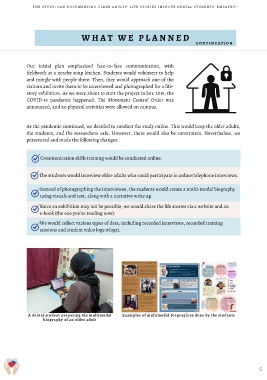
                Instead of photographing the interviewee, the students would create a multi-modal biography
                using visuals and text, along with a narrative write up.
                Since an exhibition may not be possible, we would share the life stories via a website and an
                e-book (the one you’re reading now).
                We would collect various types of data, including recorded interviews, recorded training
                sessions and student video logs (vlogs).


            A dental student preparing the multimodal  Examples of multimodal biographies done by the students
                 biography of an older adult


                                                                                                  5

