


Page 17 - Stories_of_Older_Adults
P. 17
T H E   S T U D Y :   C A N   D O C U M E N T I N G   O L D E R   A D U L T S ’   L I F E   S T O R I E S   I M P R O V E   D E N T A L   S T U D E N T S ’   E M P A T H Y ?


                 W H A T   W E   H A V E   L E A R N E D   S O   F A R


           At the end of the study, we had completed all the targeted activities. The students had also successfully
           created the biographies and write ups. We collected various types of data, including the survey results,
           session recordings and vlogs. These are still being analysed to generate the research findings. From
           conducting the study online, we have learned a lot.

           Here are some of our key lessons learned:


           When there’s a will, there’s a way
           When  the  pandemic  hit,  we  thought  it  would  be  impossible  to  conduct  our  communication-based
           study. Thanks to online technologies and the commitment of both the dental students and older adults,
           we were able to complete our plan albeit an adapted version.


           Inter-generational contact is mutually beneficial, even when done online
           Educators in various fields have used teaching tasks that bring students into contact with members of
           the  older  generation.  Such  tasks  include  community  work,  service  learning  and  life-story
           documentation.  These  tasks  are  designed  to  improve  the  students’  soft  skills,  build  humanistic
           qualities and expose students to different people and perspectives. While these tasks are usually done
           face-to-face, our study demonstrated that an online approach is also possible.  The positive feedback
           we received from the older adults and the dental students indicates that both groups had enjoyed the
           experience. The dental students reported a change in how they viewed older people. Several said they
           had more confidence in talking to older people and that their communication skills had improved. In
           turn, the older adults expressed positive feelings about contributing to the students’ learning. Several
           said they enjoyed the chance to share their life lessons.


           Dental students are creative!
           People  may  think  that  dental  students  are  more
           inclined  to  science  and  geeky  work.  However,  we
           found that they enjoyed the chance to be creative.
           During our training sessions, they were enthusiastic
           and active participants. As a result, they honed their
           skills in using words and visuals. We think that their
           biographies   demonstrate   their   artistic   and
           storytelling talents. You can judge this for yourself,
           when you read the next section of this book.
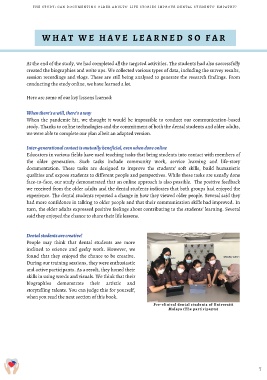
                                                          Pre-clinical dental students of Universiti
                                                                Malaya (The participants)


                                                                                                  7

