


Page 75 - AUN_DPPnet_Journey_of_Glory_Book
P. 75
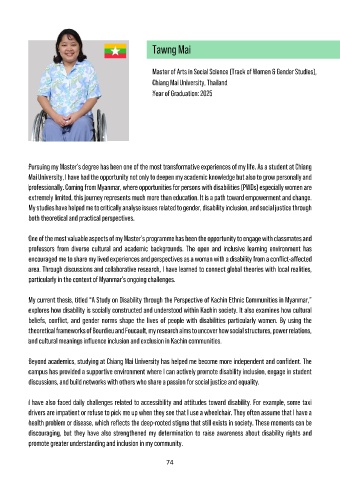
Tawng Mai


                                               Master ofArts in Social Science (Track of Women & Gender Studies),


                                               Chiang MaiUniversity, Thailand

                                               Year of Graduation: 2025


          Pursuing my Master’s degree has been one of the most transformative experiences of my life. As a student at Chiang
                                                                                     personally and

          Mai University, I have had the opportunity not only to deepen my academic knowledge but also to grow

                                                                          (PWDs)

          professionally. Coming from Myanmar, where opportunities for persons with disabilitiesespecially women are
          extremely limited, this journey represents much more than education. It is a path toward empowerment and change.
          My studies have helped me to criticallye issues related to gender, disability inclusion, and social justice through
                                      analys


          both theoretical and practical perspectives.

          One of the most valuable aspects of my Master’s programhas been the opportunity to engage with classmates and
                                                    me

          professors from diverse cultural and academic backgrounds. The open and inclusive learning environment has
          encouraged me to share my lived experiences and perspectives as a woman with a disability fro
                                                                                m a conflict
                                                                                         -
                                                                                         affected
          area. Through discussions and collaborative research, I have learned to connect global theories with local realities,
          particularly in the context of Myanmar’s ongoing challenges

                                                      .

          My current thesis, titled “A Study on Disability through the Perspective of Kachin Ethnic Communities in Myanmar,”
          explores how disability is socially constructed and understood within Kachin society. It also examines how cultural
          beliefs, conflict, and gender norms shape the lives of people with disabilities particularly women. By using the
          theoretical frameworks of Bourdieu and Foucault, my research aims to uncover how social structures, power relations,
          and cultural meanings influence inclusion and exclusion in Kachin communities.


          Beyond academics, studying at Chiang Mai University has helped me become more independent and confident. The
          campus has provided a supportive environment where I can actively promote disability inclusion, engage in student

          discussions, and build networks with others who share a passion for social justice and equality.

          I have also faced daily challenges related to accessibility and attitudes toward disability. For example, some taxi
          drivers are impatient or refuse to pick me up when they see that I use a wheelchair. They often assume that I have a
          health problem or disease, which reflects the deeprooted stigma that still exists in society. These moments can be
                                               -
          discouraging, but they have also strengthened my determination to raise awareness about disability rights and
                                                   munity.

          promote greater understanding and inclusion in my com
                                                    74

