


Page 67 - AUN_DPPnet_Journey_of_Glory_Book
P. 67
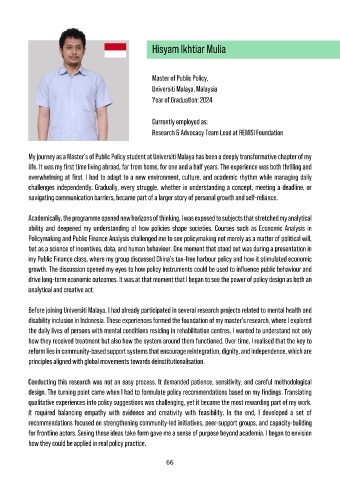
Hisyam Ikhtiar Mulia


                                               Master ofPublic Policy,


                                               Universiti Malaya, Malaysia


                                               Year of Graduation: 2024


                                               Currently employed as:


                                               Research & Advocacy Team Lead at REMISI Foundation


          My journey as a Master’s of Public Policy student at Universiti Malaya has been a deeply transformative chapter of my
          life. It was my first time living abroad, far from home, for one and a half years. The experience was both thrilling and
          overwhelming at first. I had to adapt to a new environment, culture, and academic rhythm while managing daily
          challenges independently. Gradually, every struggle, whether in understanding a concept, meeting a deadline, or

          navigating communication barriers, became part of alarger story of personal growth and self
                                                                               reliance.

                                                                              -

          Academically, the programme opened new horizons of thinking. I was exposed to subjects that stretched my analytical
          ability and deepened my understanding of how policies shape societies. Courses such as Economic Analysis in
          Policymaking and Public Finance Analysis challenged me to see policymaking not merely as a matter of political will,
          but as a science of incentives, data, and human behaviour. One moment that stood out was during a presentation in
                                                         -
          my Public Finance class, where my group discussed China’sfree harbour policy and how it stimulated economic

                                                      tax
          growth. The discussion opened my eyes to how policy instruments could be used to influence public behaviour and
          drive longterm economic outcomes. It was at that moment that I began to see the power of policy design as both an
                 -

          analytical and creative act.

          Before joining Universiti Malaya, I had already participated in several research projects related to mental health and
          disability inclusion in Indonesia. These experiences formed the foundation of my master’s research, where I explored
          the daily lives of persons with mental conditions residing in rehabilitation centres. I wanted to understand not only
          how they received treatment but also how the system around them functioned. Over time, I realised that the key to
          reform lies in communitybased support systems that encourage reintegration, dignity, and independence, which are
                            -
          principles aligned with global movements towards deinstitutionalisation.


          Conducting this research was not an easy process. It demanded patience, sensitivity, and careful methodological
          design. The turning point came when I had to formulate policy recommendations based on my findings. Translating
          qualitative experiences into policy suggestions was challenging, yet it became the most rewarding part of my work.
          It required balancing empathy with evidence and creativity with feasibility. In the end, I developed a set of
                                                                                         -
          recommendations focused on strengthening communityves, peersupport groups, and capacitybuilding
                                                    -
                                                                   -
                                                    led initiati
          for frontline actors. Seeing these ideas take form gave me a sense of purpose beyond academia. I began to envision

          how they could be applied in real policy practice.
                                                    66

